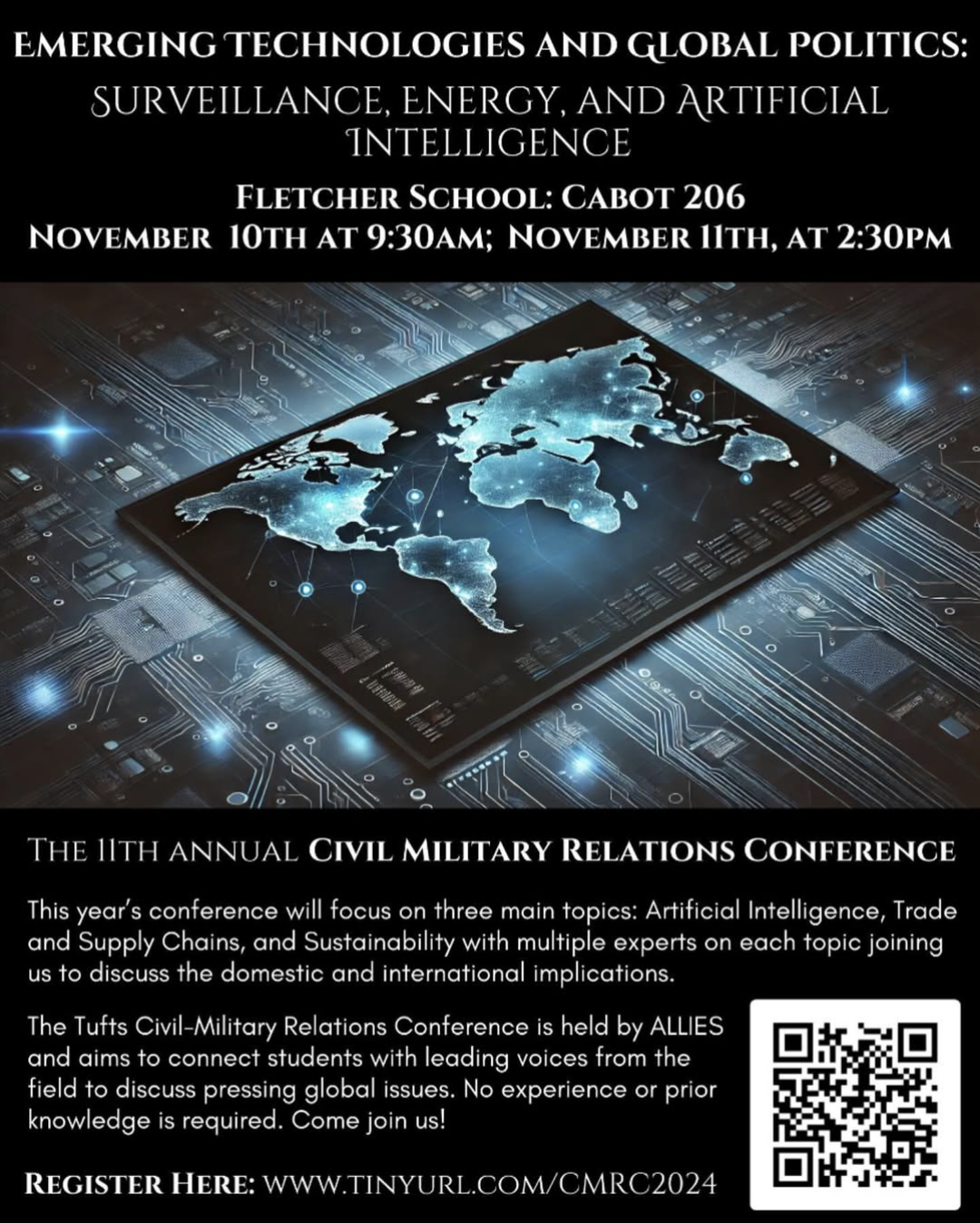
Emerging Technologies and Global Politics: Surveillance, Energy, and Artificial Intelligence
2024 ALLIES Civil-Military Relations Conference
November 10-11, 2023
KEYNOTE SPEAKER
Dr. Josephine Wolff is an associate professor of cybersecurity policy at The Fletcher School at Tufts University. Her research interests include liability for cybersecurity incidents, cyber-insurance, government responses to cyberattacks, and the economics of information security. She is the author of two books: “You’ll See This Message When It Is Too Late: The Legal and Economic Aftermath of Cybersecurity Breaches” (MIT Press, 2018) and “Cyberinsurance Policy: Rethinking Risk in an Age of Ransomware, Computer Fraud, Data Breaches, and Cyberattacks” (MIT Press, 2022). Her writing on cybersecurity has also appeared in the Financial Times, the Wall Street Journal, Slate, The New York Times, The Washington Post, The Atlantic, and Wired. Prior to joining Fletcher, she was an assistant professor of public policy and computing security at the Rochester Institute of Technology and a fellow at the New America Cybersecurity Initiative and Harvard’s Berkman Klein Center for Internet & Society.
10:30am
Panel 1: Technology and the Development of Artificial Intelligence
Prof. Matthias Sheutz is a Karol Family Applied Technology Professor of computer science in the Department of Computer Science at Tufts University in the School of Engineering, and Director of the Human-Robot Interaction (HRI) Laboratory and the HRI Masters and PhD programs. He has over 400 peer-reviewed publications in artificial intelligence, artificial life, agent-based computing, natural language understanding, cognitive modeling, robotics, human-robot interaction and foundations of cognitive science. His current research focuses on complex ethical AI-enabled robots with natural language interaction, problem-solving, and instruction-based learning capabilities in open worlds.
Dr. Jason Rife is a Professor and Chair of the Department of Mechanical Engineering at Tufts University. He directs the Automated Systems and Robotics Laboratory, which applies theory and experiment to characterize integrity of autonomous vehicle systems. He received his Bachelors in Mechanical and Aerospace Engineering from Cornell University and his Masters and Ph.D. degrees in Mechanical Engineering from Stanford University.
Dr. Elaine Short is an Assistant Professor of Computer Science at Tufts University. She holds a PhD and Masters in Computer Science from the University of Southern California and a Bachelors in Computer Science from Yale University. Her research applies human-centered design and disability community values to the development, deployment, and evaluation of AI and machine learning for robotics. She is as committed to human-centered research practices as she is to algorithm and robot design: her work spans from designing a low-cost open-source open-hardware robot platform, to understanding family group interactions with socially assistive robots and to designing new neural network architectures for improving human-in-the-loop robot learning. As a disabled faculty member, Elaine is particularly passionate about disability rights in her service work. She is a co-PI of AccessComputing and co-Chair of AccessSIGCHI, an advocacy group that works to increase the accessibility of the 24 SIGCHI conferences.
1:30pm
Panel 2: Technology and Global Supply Chains
Joel P. Trachtman is Professor of International Law at The Fletcher School of Law and Diplomacy. Recent books include “Advanced Introduction to International Trade Law” (Elgar 2020), “Collected Essays: Trade Law, Domestic Regulation, and Development” (World Scientific 2015), and “The Future of International Law: Global Government” (Cambridge 2013). Prof. Trachtman has served as a member of the Boards of the American Journal of International law, the European Journal of International Law, the Journal of International Economic Law, the Cambridge Review of International Affairs, and the Singapore Yearbook of International Law. He has consulted for a number of governments and international organizations, including the United Nations, the World Bank, and the OECD. From 1998 to 2001, he was Academic Dean of The Fletcher School, and during 2000 and 2001, he served as Dean ad interim. He has been a visiting professor at Basel, Hamburg, Harvard, Hebrew, Hong Kong, and Pretoria universities. He graduated in 1980 from Harvard Law School, where he served as editor in chief of the Harvard International Law Journal, and practiced in New York and Hong Kong for 9 years before entering academia.
Professor Enrico Spolaore is the Seth Merrin Chair and Professor of Economics at Tufts University and a Research Associate at the National Bureau of Economic Research (NBER). He holds a Doctorate in Political Economy from the University of Siena and a Ph.D. in Economics from Harvard University. His main research interests are in political economy, economic growth and development, and international economics. His publications include articles in academic journals (American Economic Review, Quarterly Journal of Economics, Review of Economic Studies, and others), chapters in edited volumes, and the book The Size of Nations, co-authored with Alberto Alesina (MIT Press). He is also the editor of the book Culture and Economic Growth (Edward Elgar).
Jonathan Colehower leads UST’s global operation and supply chain management practice. He earned his undergraduate degree in Economics and German at the University of Richmond and his MBA in Operations Research at Vanderbilt University. Before UST, Johnathan served as the Chief Marketing Officer at Manhattan Associates, as an Associate Partner at McKinsey & Co., as CEO of an early-stage software company, as head of a team at Oracle Corporation, as an Associate Partner at Accenture, and As Territory Manager for large grocery, drug, and mass merchandise retailers in New York City for Johnson & Johnson. Johnathan has developed expertise in the areas of operations management, supply chain management, and enterprise software. He has numerous publications, including his recent 2023 article for the Harvard Business Review, “Using Technology to Improve Supply-Chain Resilience”.
Monday, November 11
2:30pm
Panel 3: Technology and Sustainability
Professor Yi Ming is the Institute Professor of Climate Science and Society and Professor of Earth and Environmental Sciences at Boston College. Professor Ming uses climate models, observations and theories to elucidate the physical mechanisms governing Earth’s climate system and applies the fundamental understanding to practical issues of societal and policy importance. He has authored more than one hundred peer-reviewed papers, and mentored a number of Ph.D. students and postdocs. His honors include the U.S. Presidential Early Career Award for Scientists and Engineers (PECASE), the World Meteorological Organization (WMO) Norbert Gerbier-Mumm International Award, the American Meteorological Society (AMS) Henry G. Houghton Award and the American Geophysical Union (AGU) Ascent Award. Previously, Professor Ming was a Senior Scientist and Divisional Leader in the U.S. National Oceanic and Atmospheric Administration (NOAA) Geophysical Fluid Dynamics Laboratory (GFDL). He was also a faculty member of the Program in Atmospheric and Oceanic Sciences (AOS) at Princeton University.
Mike Perry is a Chief technologist at Largo Clean Energy and the sole proprietor of Flow Cell Tech, LLC. He previously worked for 20+ years at the former United Technologies Corporation where he led multiple teams focused on advanced electrochemical-flow-cell technologies, such as fuel cells, redox flow batteries, and electrolyzers. This work included developing what the U.S. DOE’s ARPA-E office has described as a “breakthrough flow battery stack.” This technology was successfully scaled up to a complete product via a close collaboration between Mr. Perry team at United Technologies Research Center and Vionx Energy (which was subsequently acquired by Largo and renamed Largo Clean Energy). Mr. Perry has been the Principal Investigator on four different ARPA-E projects. In 2019, he was inducted as a Fellow of the Electrochemical Society in recognition for his “key innovations in fuel cells and redox flow batteries,” and he is a named inventor on 85 issued U.S. Patents to date. Prior to starting his R&D career, Mr. Perry was an officer and aviator in the U.S. Navy, and he is a veteran of the 1991 Gulf War.
Dr. Matthew Feely is a native of Dedham, Massachusetts. He graduated from the U.S. Naval Academy, earned an MBA and Ph.D. at the University of Pennsylvania, and graduated with distinction from the National Defense University. In addition to teaching at Tufts, Professor. Feely provides thought leadership to the U.S. Defense Department, provides leadership lectures to Senior Executive Program participants at Columbia Business School, and mentors senior military officers from the U.S. and partner nations studying National Security Strategy at the U.S. Army War College. His most recent work includes: assessing the challenges global climate change presents to logistics operations, building a concept of logistics support for military forces operating in the Pacific, and providing a technical and operational assessment of the employability of a technology that produces fuel from seawater.


